
Driving Cambodia, by Marvin Mantel.
Note from Chris, Mototom
I really enjoyed reading this text by Marvin Mantel on Facebook and felt it honestly and usefully depicted Cambodian traffic culture. With Marvin’s agreement, I am happy to share it here, as it may help others better understand how driving in Cambodia actually works. I often compare Cambodian traffic with the flow of a river. You can go whenever you can see a natural gap, as long as you can read others’ intentions and know some basics that Marvin accurately describes below. Ride safe! - Chris, Mototom.
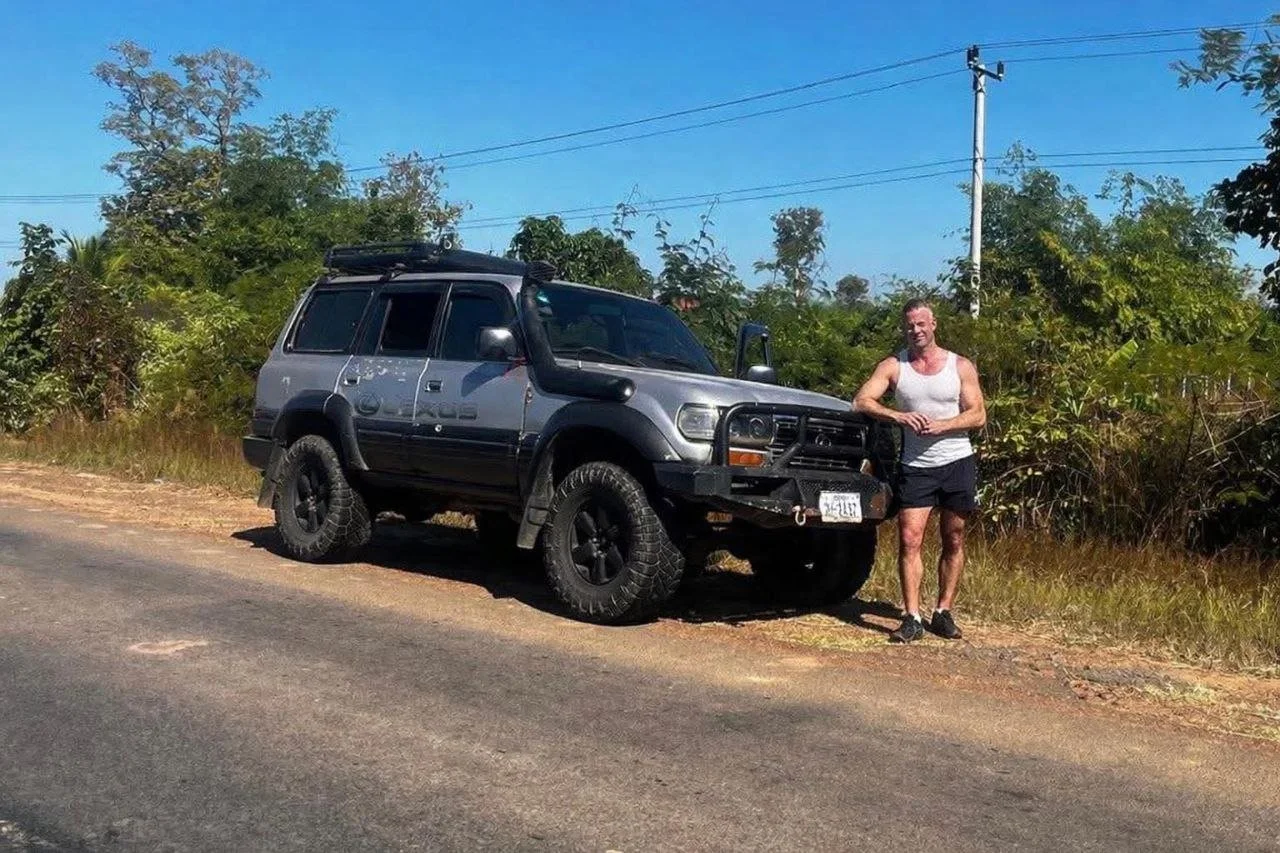
Marvin, posing next to his Lexus LX 4×4.
Driving in traffic in Cambodia
Before our holiday in Cambodia, many people advised me not to drive myself in Cambodia. It would be super dangerous and everyone drives like maniacs. Stubborn as I am, I did it anyway, and after almost 2000 km by car, several hundred kilometers by scooter, a few tuk-tuk and minibus rides in the back, and a reasonable amount of traffic insight, I think I can fairly say how traffic in Cambodia works.
Everyone thinks that rules do not apply in Cambodia. I have noticed that this is not true. There are many unwritten rules and almost everyone follows them.
The most important rule is the right of the strongest. With our big 4x4 we were just above average. Trucks are the top predators and bicycles and scooters are hanging at the bottom (we will discuss pedestrians later). During overtaking or at a roundabout, the smaller one adapts to the bigger one. Everyone does this, so it often goes well. If you, as a big car, suddenly want to go a different direction on a busy roundabout, you just do it, but calmly and gradually so the small ones get a chance to adapt. The small ones (scooters and tuk-tuks) have the right to fill the small gaps. The bigger ones do not really make space, but deliberately cutting someone off like we sometimes do in the Netherlands does not happen here.
Indicators
These beautiful blinking lights in all kinds of colors have an important function here and are used a lot. But in a different way than we are used to. Of course, we use them for turning left and right. Except the small ones who quickly go against traffic to get an iced coffee at their favorite coffee stall. But that does not matter. The big ones will not deliberately hit them, but we also do not brake. The small ones take care of themselves and we do not want to create a chain collision behind us.
For the bigger vehicles: on the right lane or on a road with oncoming traffic, left indicator means “I intend to overtake.” If this indicator has been on for half an hour, you do not need to flash to tell him he forgot it – he just really loves overtaking.
Left indicator on the left lane on a one-way road means “I see you want to overtake me, but I like this lane very much, so feel free to overtake me on the right.” Overtaking on the right on roads where everyone goes the same direction is completely normal. We do not change lanes unless it is to overtake or turn. So just stay nicely in your own lane.
Useless honking
Not nearly as much and as bad as in Turkish cities or Sri Lanka, but the horn is used here. Not near schools and hospitals, because it is forbidden there. Honking is done when bigger vehicles overtake smaller ones, mainly to let them know they are coming closer, or for example when a scooter wants to overtake a tuk-tuk but the car has overtaking priority.
Besides honking, there is something else often used to warn: flashing high beams. This is usually done when an oncoming vehicle is overtaking and wants to warn you. That vehicle is fond of its windshield and wants to avoid a collision.
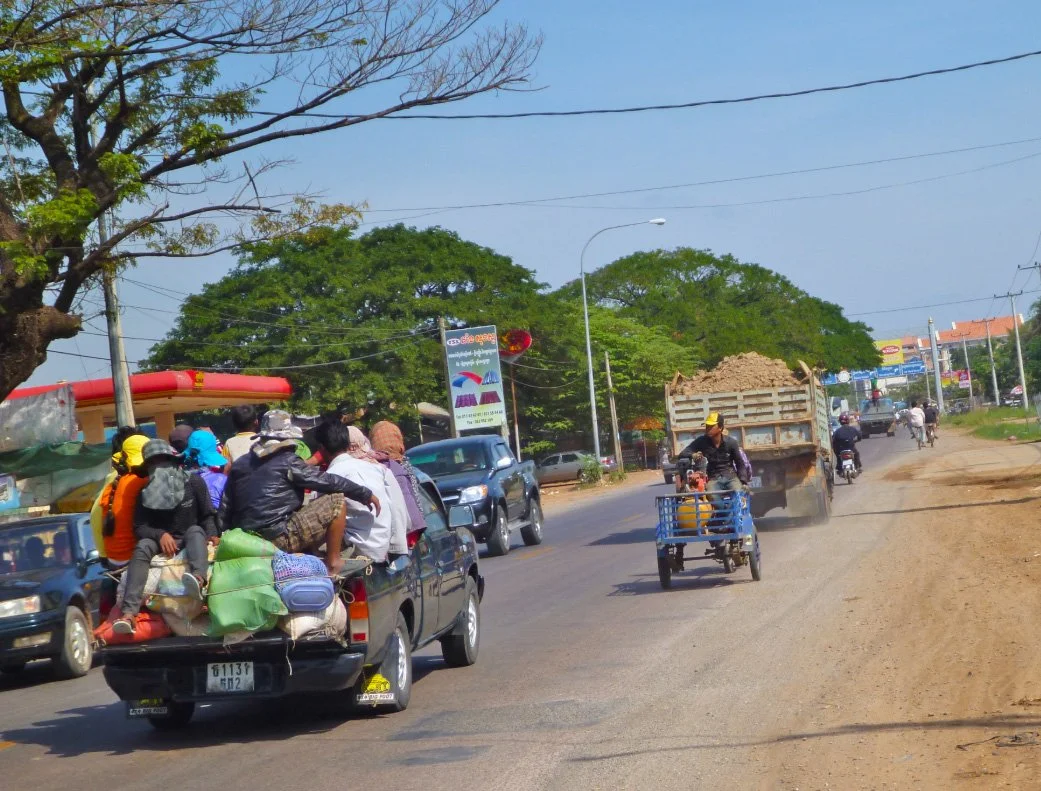
Traffic in Battambang
Overtaking
In the Netherlands, we overtake at a broken line when there is no oncoming traffic and mainly on the left side. If you do it differently, you can expect a middle finger, honking, and if unlucky, a dashcam video on social media. Possibly with an angry call from the insurance company. In Cambodia, this works a bit differently and, in my opinion, better.
Big vehicles overtake everything on the left, except on roads where everyone goes the same direction. There, you stay as long as possible in your own lane and overtake on the other lane(s). Small vehicles overtake small vehicles on the left, but big vehicles on both left and right. They do not think too much about it – they look after themselves. If you are a scooter rider, do not expect them to take you into account either and make sure you keep awareness around you.
On a two-way road, we overtake when we want to overtake. The big ones give a little honk to the small ones so they move a bit to the right, and a flash of high beams to the oncoming traffic so they also make some space. That way, you can easily fit with four vehicles on what is basically a four-lane road. If it does not fit, it is the task of the NON-overtaking vehicles to make sure it does fit, by braking a little or moving slightly into the shoulder. This takes some getting used to, but everyone does it, so just go with it. You will see that it works perfectly.
Merging and exiting
Merging requires a bit of courage. The idea is that you just go. On your own lane, not such a problem. Enter the lane and stay as far right as possible until you reach speed. Enter the lane calmly; the far-right lane belongs to the small ones and they need the chance to steer left and right around you. They really do this, so in the first meters it is important to be aware of this and not suddenly move left or right – there can easily be four scooters in your blind spot. A tap on your window or roof is often a sign that you are giving someone too little space.
The lane to the left is slightly different. You first have to cross. If it is busy, you could wait a long time, but we do not wait, so just go. The first cars will go around you, but when they really cannot anymore, they will brake. The small ones will quickly pass behind you and eventually the big ones as well, so you end up halfway. Do not cross at a right angle; you want to end up on the far-left lane of your direction. Stay there until you want to change, the cars in your direction will simply overtake you on the right.
Then we have roundabouts. This is a story on its own. There are roundabouts and there are circular roads. The difference? On a roundabout, traffic on the roundabout has priority. On a circular road, right has priority. How do you recognize the difference? Usually by a very worn stop line on the circular road, which is not present on a roundabout. You will recognize them quickly by the traffic.
Small detail: most vehicles drive these roundabouts clockwise, but the small ones sometimes cut through against the direction. Do not pay attention to it; they take care of themselves.
Traffic lights
Red is stop and green is go. So far, very easy. Some small ones, however, are color-blind, visually impaired, or not very interested in traffic lights, and they do not always use them. Do not honk, no middle finger, and running them over is also not nice. Do not make an emergency stop either, because the car behind you that also has green does not expect that. The scooter rider has probably judged very well that it fits, and even if he comes a bit closer than you are used to, it will be fine.
Solid lines, traffic signs, and lights should be seen more as recommendations than rules. Except for one type: men with or without a yellow vest, a glowing stick, and a whistle. These are the most powerful of the powerful and walk straight into the road without hesitation, after which everyone is expected to stop so that a vehicle can safely leave the exit of a restaurant, expensive shop, or important office. Advice is to stop for them, because they can whistle very loudly and look very angry.
If you go scooter riding, mainly make sure you take care of yourself. Big vehicles will not just run you over, but they do expect some traffic insight and proactive driving. So keep moving nicely. Luckily, tourists are quite easy to recognize and they take a little extra care of us. Just like we take a little extra care with Asian tourists on bicycles in Amsterdam.
If everything is a bit too fast or too busy, just pull over. Pulling over means into the shoulder or onto the sidewalk, mainly because the side of the road is also just used for driving. This is not strange at all and Cambodians do it too when it becomes a bit too much.
Do not be surprised if you have to go off-road a bit on a scooter. That is normal and no rental company worries about it. Especially keep giving gas on sandy roads and do not brake too hard with your front brake, then everything will be fine.
Fuel
Petrol, diesel, and LPG are available everywhere in the country. For scooters, often in cola bottles at roadside stalls. A liter is on average one dollar at the petrol station, and a 1.5-liter cola bottle is 2 or 2.5 dollars.
Do not be surprised if your 50-liter tank is suddenly filled with 55 liters. You sometimes get a bottle of cold water and a clean windshield in return. And the toilets at all petrol stations are also a nice idea (bring your own toilet paper if you want to use it).
Finally, I want to mention the pedestrian. It is great to sit on a bench on a busy morning and watch walking tourists who want to cross the road. They sometimes stand there for a few minutes and then decide to walk a bit further. Here too, the rule is just go. The small ones quickly go around you and the big ones do not drive over your toes. Walk on until you are close to the big vehicles and then with a quick hop to the middle lane. From here, first get through the big ones again and then make sure the small ones avoid you. Do not expect too much from a zebra crossing. It is more seen as “pay attention, this could be a place where pedestrians might want to cross, so try to avoid them.”
I personally think that if you understand the above rules a bit and dare to trust them, it is quite safe to drive. Because of the “lack” of rules, everyone pays much more attention in traffic and fewer mistakes are made than in the Netherlands.
I am very curious how other people experienced traffic in Cambodia and whether you have any additions.
If there are questions from people who are also going to take the step, I am happy to try to answer them as well as possible.
Regards,
Marvin
